Swansea Minster
Historic Brass Rubbing
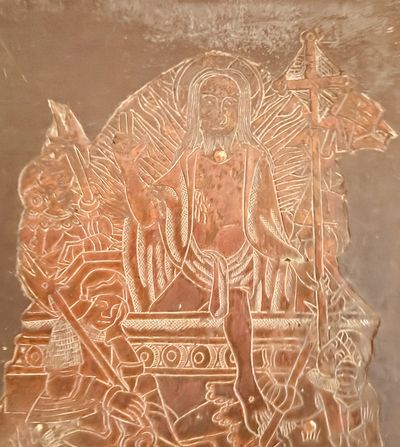
To celebrate Easter, April’s Monument of the Month commemorates a Knight of the Holy Sepulchre and has a plaque showing Christ stepping out of his tomb, over the sleeping guards, carrying the banner of the Resurrection.
The church suffered badly during the Blitz. As well as the damage to Hugh and Maud’s brass, the magnificent alabaster tomb which Maud’s cousin Matthew Cradock commissioned for himself and his second wife Lady Katherine Gordon (she was a member of the Scottish royal family and Perkin Warbeck’s widow) was destroyed by a combination of fire, water and a botched attempt at conservation. A third effigy tomb was already battered and is now virtually unidentifiable.
Brass monuments are rare in Wales. In an article in the Transactions of the Monumental Brass Society for 2009, Rhianydd Biebrach identified about twenty, including lost brasses and indents. Of these, only seven survive in their original location. The usual explanation is Wales’s remoteness and poverty, though this cannot be the whole story. Of the lost indents, five were in St David’s Cathedral. One at least was a lavish product with the stone completely covered by a brass plate: Sally Badham has suggested that this could have been a Flemish brass. Good quality stone for carving was readily available in Wales, and the upper gentry seem to have gone for alabaster effigy tombs rather than brasses. As with so much else, the answer may lie (as Rhianydd Biebrach suggests) with the vagaries of fashion.